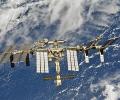
Once ISRO masters the technology to send humans into space, the next step will be experimenting with technologies allowing humans to live in space.

'The heat shield technology for re-entry vehicles was first mastered in DRDO for the Agni missile.' 'This is why the Americans were so opposed to Agni in the 1980s, unlike other missiles -- it was a re-entry vehicle.'

Experts said India has possessed the anti-missile technology for several years but needed the political go-ahead to actually test it in live conditions.
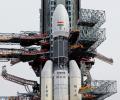
'It is time we Indians learnt to believe in ourselves, and stopped questioning our own capabilities every time a space launch is not a glorious success,' says M D Riti.
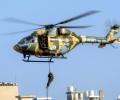
'The tools of warfare are changing. The MoD must deepen its engagement with technology thinkers that can present compelling visions of where warfare may be heading.'

After a comprehensive analysis is undertaken to find the reasons of this incident, "we will build an elaborate plan to avert any potential tragedy going forward", Rawat said.
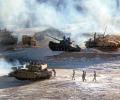
While tensions have eased at several friction points and mechanisms for managing the boundary have been reactivated, underlying differences persist. Disputes over naming practices in Arunachal Pradesh, continued infrastructure development on both sides, and unresolved questions regarding patrolling rights indicate that the structural gap remains, notes Dr Kumar.

Currently in its advanced development phase, the team is focusing on refining the robot's ability to understand and execute operator commands.

'With India's growing capabilities in the space sector, this creates promising opportunities for enhanced collaboration and market access.'

Nibe Space (NSPL), a subsidiary of Nibe, announced its vision to establish India's first multi-sensor, all-weather, high-revisit Earth observation satellite constellation. Aiming to strengthen India's self-reliance in the strategically crucial defence-space sector, NSPL signed memoranda of agreement with Indian and global partners, including Larsen & Toubro, Centum, AgniKul, Skyroot Aerospace, SpaceFields, SISIR Radar, CYRAN AI Solutions, and Thales Alenia Space as a technology partner.
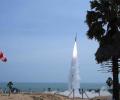
The fuel cost will come down if rockets are launched from Kulasekarapattinam as they will have a straight trajectory and need not have to avoid Sri Lanka, which is being done by rockets flown from Sriharikota.
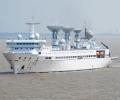
The southern deep-sea port of Hambantota is considered strategically important for its location.

Once deployed and operational, it will be used to support the satellite imagery requirements of various agencies within the government of Singapore.

Dr Bhabha and Dr Sarabhai didn't feel guilty for their ambitions; it was for those 'mad scientists' that India is a powerhouse -- both at the atomic level and in the vastness of space, observes Kumar Abishek.

This visa issue had gotten so embarrassing that former Defence Secretary William Cohen, now a member of the US-India Business Council's board of directors, who was presiding along with Ambassador Nirupama Rao at the launch, had to prevail upon Secretary of State John F Kerry and get the visas okayed.
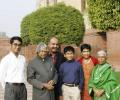
'I still remember back in 1971, the night they both got the news that Dr Vikram Sarabhai had died at his hotel in Kovalam, and rushing off with tears in their eyes.'
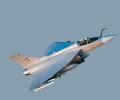
'An HAL-private sector tieup is a possibility.'

Astronaut Shubhanshu Shukla returns to Earth after an 18-day mission aboard the International Space Station, marking a significant milestone for India's space program and carrying out crucial scientific experiments.

The primary satellite TeLEOS-2 is a synthetic aperture radar satellite developed under partnership between Defence Science and Technology Agency (DSTA) representing the Government of Singapore and ST Engineering.

The prompt approval to set up a radar station on the Andaman and Nicobar Islands signalled the Modi government's intent to deal with China on its own terms.
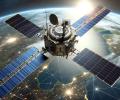
India is marching towards becoming the fourth country in the world to have space docking technology.

Aero India, the largest air show in Asia and one of the world's most important military aviation exhibitions, is all set to kick-start at Yelahanka Air Force Station in Bangalore, from February 6 to 11.

Here are photos from his life and career as India's pre-eminent defence scientist and one of the country's most popular president
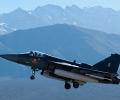
Among the programmes suffering from this lack of leadership is the Tejas Light Combat Aircraft project.

Out of its 47 operational satellites, India currently has six to eight satellites which are used entirely for military purposes.
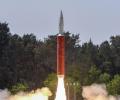
He said the country now possesses the capability to strike satellites in outer space with centimetre-level accuracy and precision.
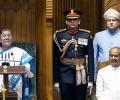
President Droupadi Murmu addressed both Houses of Parliament, highlighting the government's achievements in various sectors, including economic growth, social welfare, and infrastructure development. She emphasized the government's efforts to lift the economy out of "policy paralysis" and create a more inclusive society. Murmu also acknowledged the challenges posed by digital fraud and cybercrime and stressed the need for a social infrastructure revolution. The President's speech is considered a policy statement, outlining the government's vision and roadmap for the future.
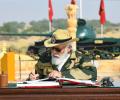
National Security Advisor Ajit Doval, Chief of Defence Staff General Bipin Rawat, Chief of Army Staff General Manoj Mukund Naravane, Chief of Naval Staff Admiral Karambir Singh, Chief of Air Staff Air Chief Marshal Rakesh Kumar Singh Bhadauria, along with all the Commander-in-Chief rank officials from the three services will be attending the conference.

There was no word on the much-anticipated procurement of 26 naval variants of Rafale fighter jets by India from France.
Godrej and some other firms are frustrated at what they say is the slow execution of projects and lack of government support, which are hampering India's efforts to compete with China and Russia as a cheaper option for launching satellites.

Late former President APJ Abdul Kalam's inspiring and motivational message and minimalistic lifestyle forms the basis for a new art based web comic.

Officials hint the visit could finally see a formal defence industrial road map being adopted by both nations.

In the years to come, India's space assets will play a much bigger role if and when hostilities break out on our borders, says Pallava Bagla.

In a double-dose bid to boost growth and employment prospects, the Union Cabinet on Tuesday approved a Rs 2.07 trillion outlay for a research development and innovation (RDI) Scheme to fund private sector innovations, and an employment-linked incentive (ELI) to create over 35 million new jobs over the next two years.

GSLV-MK III, which uses a homegrown cryogenic engine, has to do at least two more launches before it begins commercial operations, report Raghu Krishnan and T E Narasimhan.

During the day-long debate, the lines between science and religion often got blurred with many invoking religious texts and the contribution of 'rishi munis' to highlight India's tryst with the extra-terrestrial world.

India has its share of both large tech companies and large national laboratories, but why is it that these don't seem to be at the forefront of any innovation news headlines? asks Ajit Balakrishnan.

The VL-SRSAM, which DRDO developed for the Indian Navy, was fired from a warship at a high-speed aerial target mimicking incoming enemy aircraft.

Pride is all ours and of those who made a beeline to Halls 3 and 5 that showcased indigenous defence technologies at the Make In India Week.

The first Gaganyaan flight scheduled for 2022 will carry three astronauts, who will be picked from among the test pilots in the armed forces.
